When people think about the PoSH Act, they often focus on complaints, investigations, or workplace policies. However, at the heart of the entire framework lies a body that makes the law effective in practice: the Internal Committee (IC).
The PoSH Act recognizes that having a law on paper is not enough. Employees need a trusted, accessible, and impartial mechanism through which they can raise concerns and seek redressal. This is where the Internal Committee comes in. It serves as the primary body responsible for receiving, examining, and addressing complaints of sexual harassment within an organization.
What is an Internal Committee?
An Internal Committee, commonly known as the IC, is a committee that every organization with 10 or more employees is required to constitute under the PoSH Act, 2013. Its purpose is to ensure that complaints of workplace sexual harassment are handled fairly, confidentially, and in accordance with the law.
Think of the IC as the organization’s first line of support and redressal for employees who experience sexual harassment. It is not merely a compliance requirement. It is a critical mechanism designed to protect dignity, promote accountability, and foster a culture of respect and safety in the workplace.
Why Was the Internal Committee Introduced?
Before the PoSH Act came into force, many employees did not know whom to approach when they experienced harassment. Even when they reported incidents, complaints were often handled informally, inconsistently, or sometimes ignored altogether.
The introduction of the Internal Committee addressed this gap by creating a structured process for addressing complaints. It ensured that organizations could no longer treat workplace harassment as a private issue or a minor disagreement. Instead, it became an issue that required a formal, fair, and legally compliant response.
In essence, the IC transformed workplace safety from a matter of goodwill into a matter of legal responsibility.
Who Should Be Part of the Internal Committee?
The law carefully prescribes the composition of the Internal Committee to ensure diversity, fairness, and credibility.
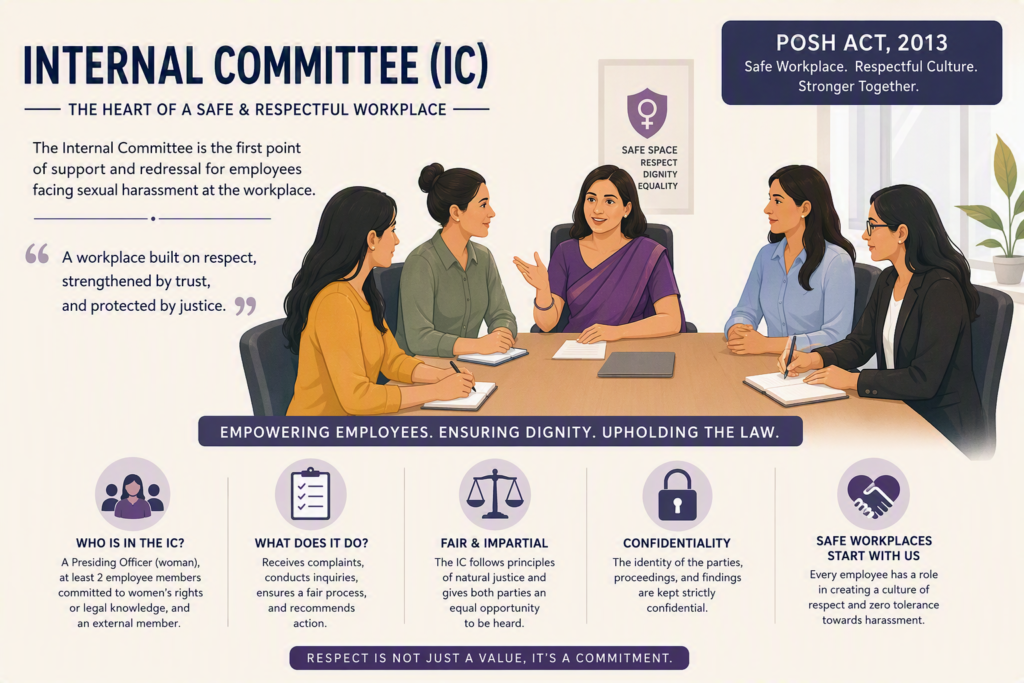
At the head of the committee is a Presiding Officer, who must be a senior woman employee within the organization. This requirement reflects the intent of the law to ensure representation and sensitivity in handling complaints involving women.
The committee must also include at least two employee members who are known for their commitment to women’s rights, social causes, employee welfare, or who possess legal knowledge and experience.
In addition, the law requires the inclusion of an external member. This individual is usually associated with a non-governmental organization, women’s rights group, or someone familiar with issues relating to sexual harassment. The presence of an external member brings independence and objectivity to the process, helping ensure that investigations are conducted without internal bias.
Importantly, at least half of the committee members must be women, reinforcing the committee’s ability to handle complaints with empathy and understanding.
What Does the Internal Committee Actually Do?
Many people assume that the IC only becomes active after a complaint is filed. In reality, its role extends far beyond investigations.
The committee plays an important role in creating awareness about workplace sexual harassment and educating employees about their rights and responsibilities. It supports organizations in promoting a culture of respect and ensuring that employees know how to seek help if needed.
When a complaint is received, the IC becomes responsible for understanding the facts, hearing both parties, reviewing evidence, speaking with witnesses where necessary, and conducting an inquiry in a fair and unbiased manner.
The committee is expected to follow principles of natural justice. This means both the complainant and respondent must be given an opportunity to present their version of events. The objective is not to assume guilt or innocence, but to arrive at a fair conclusion based on the available facts and evidence.
Does the Internal Committee Have Legal Powers?
Yes. Under the PoSH Act, the Internal Committee is granted certain powers similar to those of a civil court during an inquiry process.
This allows the committee to call individuals for hearings, examine evidence, seek relevant documents, and conduct a detailed investigation into the complaint. These powers are essential because workplace harassment cases often involve sensitive facts, conflicting accounts, and the need for careful examination.
However, with these powers comes a significant responsibility. The committee is expected to maintain confidentiality throughout the inquiry process and protect the privacy of everyone involved.
Why Is Confidentiality So Important?
One of the most important principles under the PoSH Act is confidentiality. Complaints of sexual harassment are highly sensitive and can affect personal dignity, professional reputation, and emotional well-being.
For this reason, the Internal Committee is required to keep complaint details, evidence, witness statements, and inquiry proceedings confidential. The identities of the parties involved should not be disclosed publicly.
Confidentiality encourages employees to come forward without fear of embarrassment, retaliation, or workplace gossip.
More Than a Committee, A Symbol of Trust
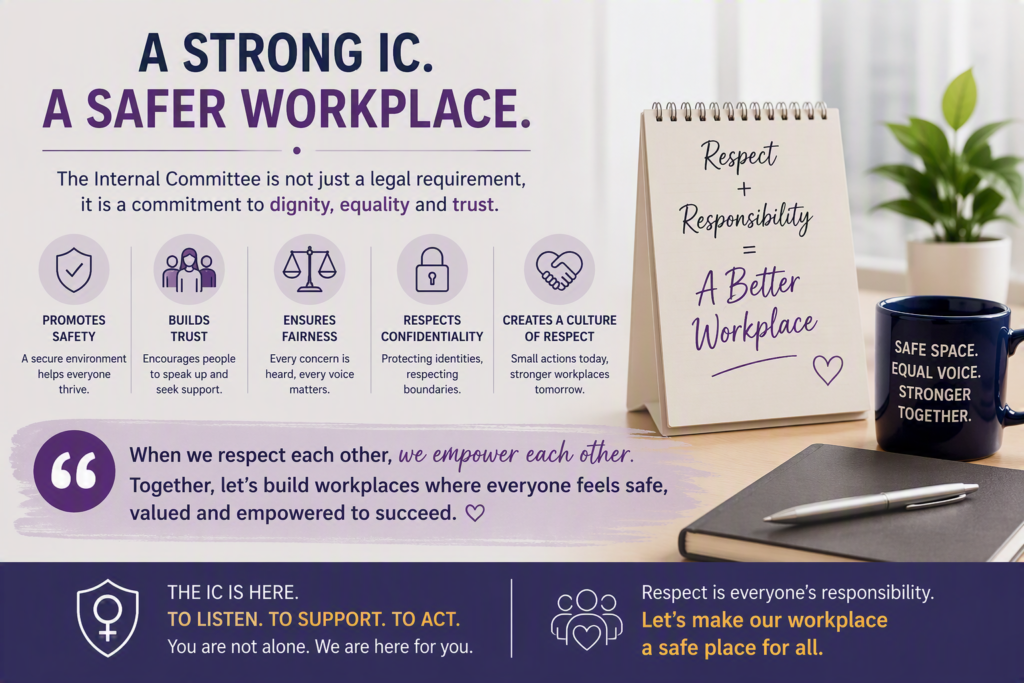
An effective Internal Committee is far more than a statutory requirement. It represents an organization’s commitment to creating a workplace where every employee feels safe, respected, and heard.
When employees trust that concerns will be addressed fairly and professionally, they are more likely to speak up, seek support, and contribute confidently to the organization. In this way, the IC becomes not just a complaint-handling body but a cornerstone of workplace culture.
Final Thoughts
The Internal Committee is one of the most significant features of the PoSH Act. By providing a structured, impartial, and confidential mechanism for redressal, it helps transform workplaces into safer and more inclusive spaces. While policies and laws set the framework, it is the Internal Committee that brings those principles to life.



Leave a Reply